2026 Global E-Cigarette Market: Growth, Transformation, and Strategic Opportunities
The global e-cigarette market in 2026 stands at a vibrant yet uncertain crossroads. On one hand, it is widely regarded as a harm reduction alternative to traditional tobacco and is expected to continue attracting hundreds of millions of adult smokers worldwide. On the other hand, increasingly stringent global regulations and restrictions targeting youth usage cast a shadow over its growth prospects. This report combines data from multiple authoritative market studies to present a data-driven panoramic view of the e-cigarette market in 2026.

1. Market Fundamentals: Sustained and Certain Growth
Despite challenges, expectations for robust growth in the global e-cigarette market in the medium term are clear. Data from multiple authoritative sources paint a similarly optimistic picture.
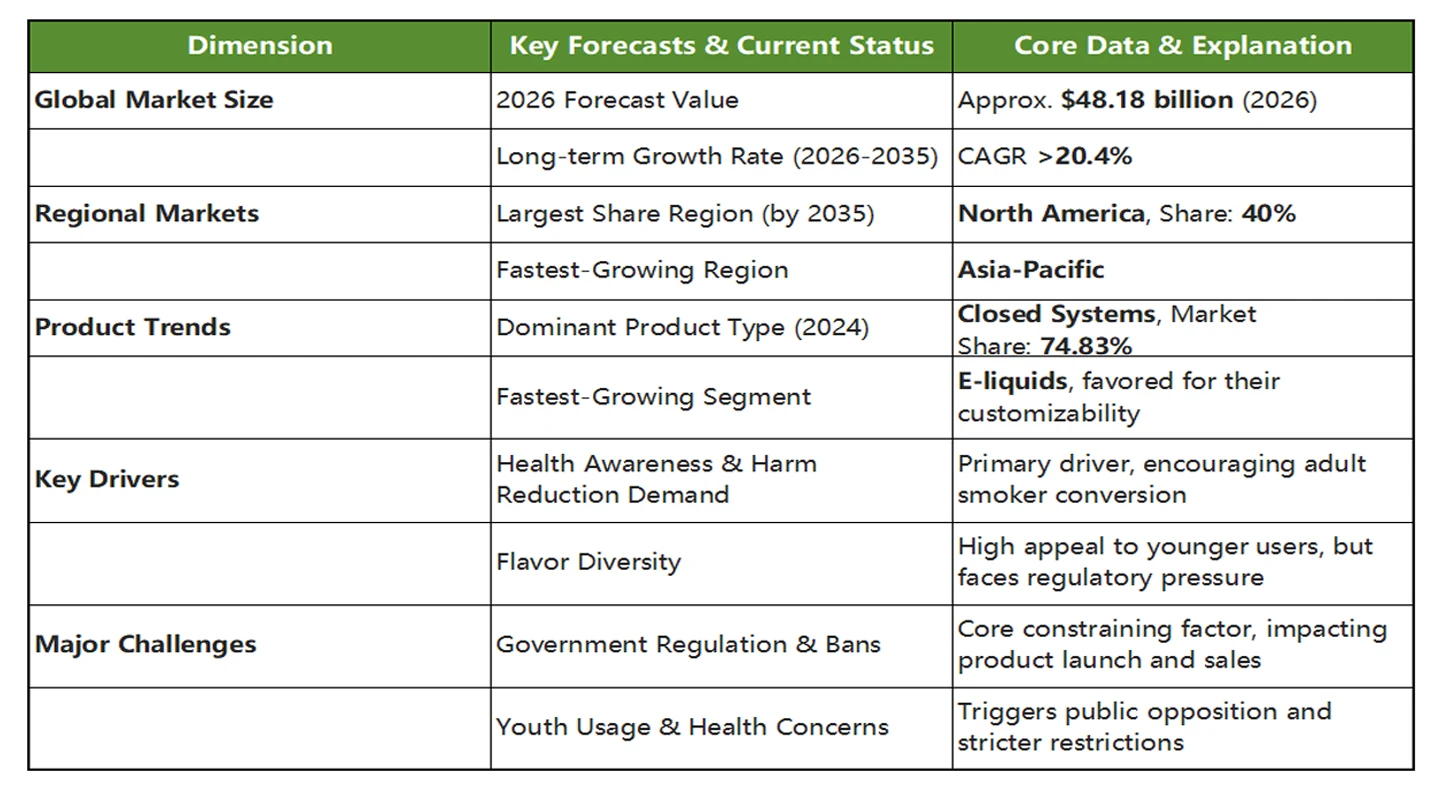
- Market Size Forecast: According to the latest report released by Research Nester in 2025, the global e-cigarette and vape market size is projected to be $40.71 billion in 2025 and grow to approximately $48.18 billion in 2026. The report further predicts that from 2026 to 2035, the market will expand at a high compound annual growth rate (CAGR) of over 20.4%. Another report forecasts that the global market, valued at about $14.1 billion in 2020, will reach $22.5 billion by 2026, with a CAGR of approximately 8.3%.
- Regional Market Landscape: Growth momentum is unevenly distributed globally.
- North America (led by the US) is expected to capture 40% of the global market share by 2035, benefiting from higher acceptance among younger demographics regarding e-cigarettes as safer alternatives. Simultaneously, the US market serves as a compliance benchmark due to its stringent regulations (e.g., FDA's PMTA review).
- Asia-Pacific is widely regarded as the fastest-growing region, primarily due to a large potential user base, rising health awareness, and growing disposable income.
- European markets, particularly the UK, Germany, and France, will maintain significant positions thanks to mature online sales channels and high user penetration.
For a clearer understanding, the table below summarizes key market data and trends:
2. Core Growth Drivers
Market growth is not accidental; it is underpinned by powerful structural drivers.
- Health Awareness & Harm Reduction Demand: This is the fundamental driver of the e-cigarette market. As global tobacco control intensifies, more adult smokers seek alternatives to traditional cigarettes. Studies indicate that e-cigarettes are considered a relatively reduced-harm option by many experts and public health agencies (e.g., Public Health England). This perception is driving large-scale user conversion.
- Flavor Innovation & Diversity: A wide range of flavor options (fruits, desserts, beverages, etc.) significantly expands the appeal of e-cigarettes. Data shows that in the US, over 87% of youth e-cigarette users use flavored products. Although flavor bans targeting youth (e.g., in some US states) pose limitations, diverse flavors remain a key factor encouraging adult smokers to switch from cigarettes.
- Technological Advancements & Product Upgrades: Ongoing technological evolution in devices continuously improves user experience. This includes longer battery life, more stable temperature control, and "smart" features connecting to smartphone apps to track usage and optimize nicotine intake. Additionally, manufacturers are exploring more eco-friendly solutions, such as solar-powered charging devices.
- Channel Penetration & Convenience: Currently, offline retail stores (e.g., convenience stores, specialty vape shops) remain the primary sales channel, holding the majority market share. However, online sales are growing at the fastest pace. Online channels offer a wider product selection, more competitive pricing, and are increasingly meeting compliance requirements through advanced age verification technologies.
3. Key Challenges & Risk Factors
While embracing opportunities, market participants must squarely face the following severe challenges:
- Increasingly Stringent Global Regulation: This is the greatest uncertainty facing the e-cigarette industry. Regulatory policies vary drastically across countries, ranging from complete bans (e.g., India) to complex pre-market authorization processes (e.g., FDA PMTA in the US). Regulations target not only the products themselves (nicotine content, ingredient safety) but increasingly also marketing methods, flavors, and sales channels (especially online sales). Compliance costs are rising sharply.
- Youth Usage & Public Health Concerns: Persistently high youth usage rates are the direct cause of tightening global regulations and societal opposition. Although the industry emphasizes its target audience is adult smokers, effectively preventing products from reaching youth is a critical public relations and operational challenge the entire industry must solve.
- Uncertainty Regarding Long-Term Health Impacts: While e-cigarettes are generally considered less harmful than traditional cigarettes, their long-term health effects remain a focus of scientific research and public debate. Any new negative research findings could have an immediate impact on market confidence and regulatory policies.
- Supply Chain & Cost Pressures: E-cigarette production relies on a complex global supply chain involving batteries, chips, atomizer cores, and e-liquid ingredients. Geopolitical tensions, changes in trade policies, and evolving compliance requirements can all lead to supply chain disruptions and increased production costs.
4. Strategic Implications for Brands & Industry Players
Facing the 2026 market landscape, e-cigarette brands (such as CAMOBAR) need to adopt strategic responses:
- Compliance First: Place compliance at the strategic core. Thoroughly understand and strictly adhere to all regulations in target markets, including product certification, ingredient disclosure, packaging warnings, and age-verified sales systems. In mature, heavily regulated markets (e.g., North America, Europe), compliance is the sole ticket for market entry.
- Clear Adult User Positioning: All product design, marketing messages, and sales channels must clearly and firmly revolve around adult smokers. Actively adopt technological measures (e.g., robust online age gates) and social responsibility initiatives to tangibly distance from the youth market.
- Focus on Technological Innovation & Differentiation: In regions with flavor restrictions, the competitive focus should shift from sheer flavor variety to enhancing product performance, quality, reliability, and harm reduction technology. Develop smarter, more eco-friendly devices with superior user experience to build a technological moat for the brand.
- Build a Resilient Supply Chain: Assess and diversify the supply chain to mitigate potential disruption risks. Establish strategic partnerships with reliable suppliers and ensure all components and raw materials meet increasingly stringent quality and safety standards.

Conclusion
In summary, the global e-cigarette market in 2026 will continue its growth trajectory, but the growth model will undergo profound changes. The market will transition from the early-stage, extensive expansion driven by marketing and flavors to a more mature stage characterized by stricter regulation, greater emphasis on product quality, and heightened social responsibility. For brands like CAMOBAR, success will no longer depend solely on sales figures but increasingly on the ability to adapt to regulation, the depth of technological innovation, and the precise understanding of core adult user needs. Only those enterprises that can successfully navigate this complex transformation will secure a favorable position in the future competitive landscape
www.camobar.net


